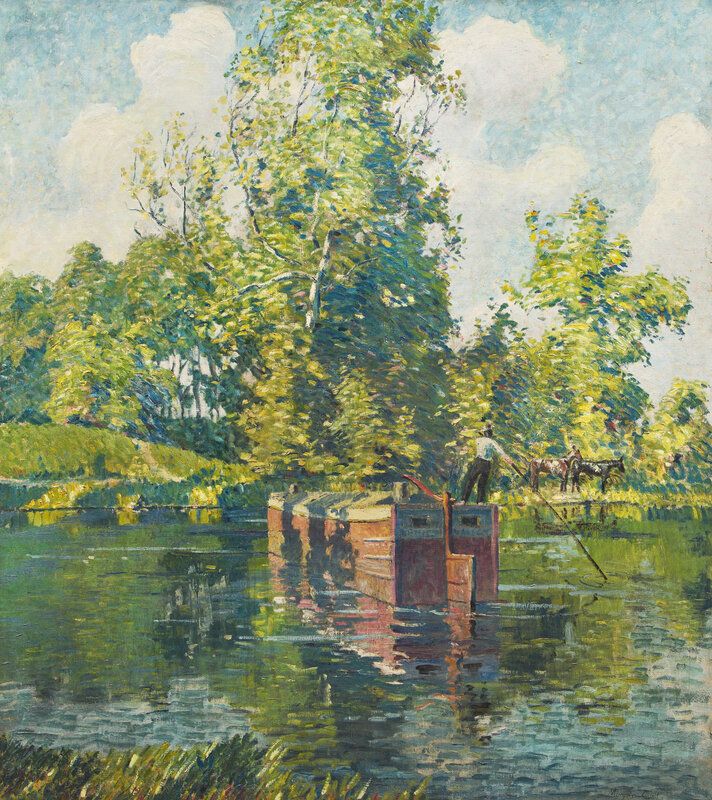
New & Noteworthy
Stay up to date with news, highlights, & features from across Freeman's.
Stay up to date with news, highlights, & features from across Freeman's.
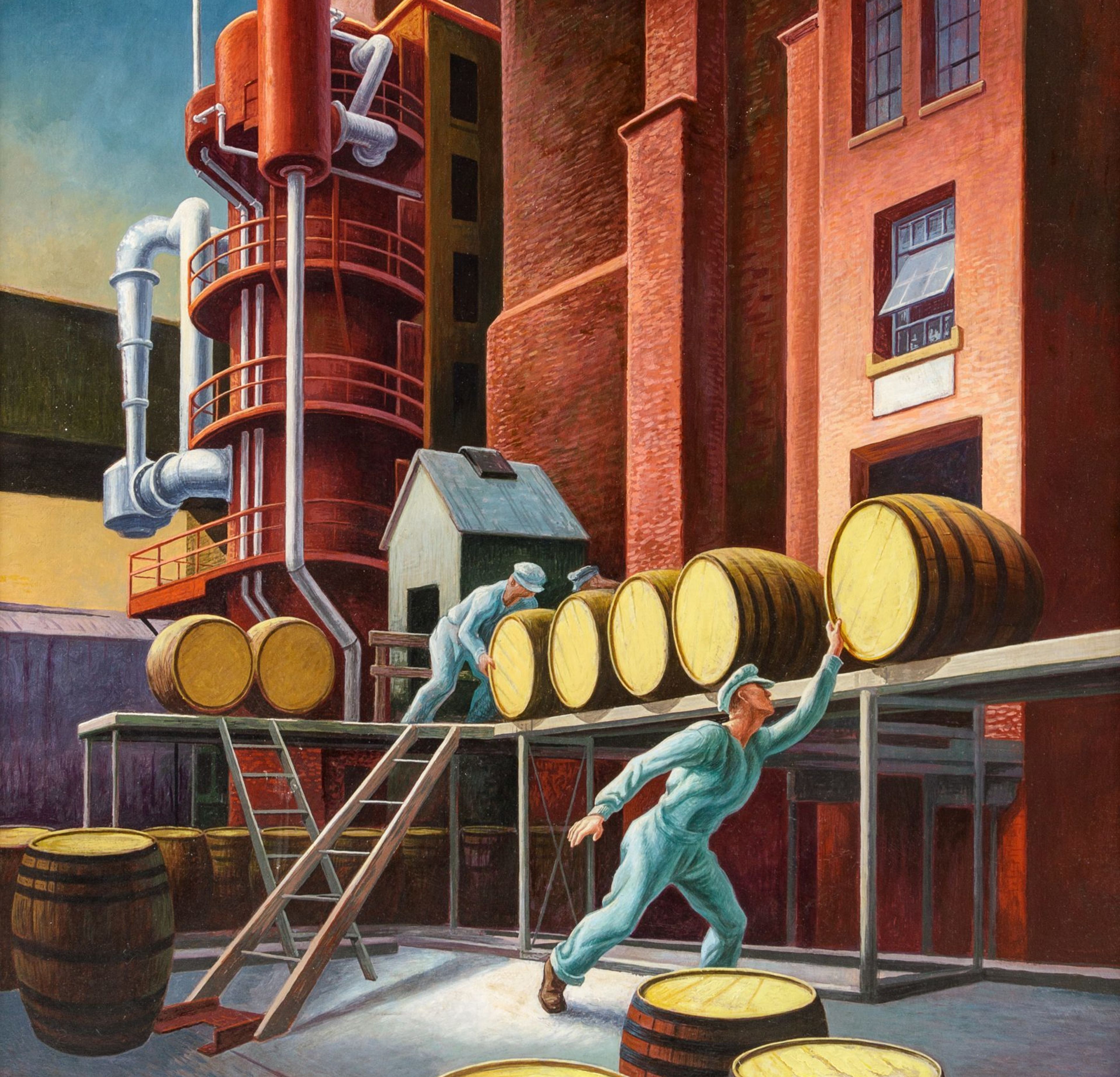
This painting Whiskey Going into the Rackhouse to Age or Whiskey Barrels, produced by Thomas Hart Benton in 1945, dates from the period of his greatest fame and prosperity, when his work was energetically promoted by the most innovative art dealer of the time, Reeves Lewenthal. Lewenthal had started his career as a reporter for the Chicago Tribune, but then drifted into promotional work, particularly representing artists. In doing so, he became convinced that the art world was operating on an outmoded business model and needed to adjust to the new realities of the modern age. In 1934 he started a print gallery, Associated American Artists, to test his ideas. Associated American Artists started in July 1934, when twenty-three artists met in Thomas Hart Benton’s New York studio. Despite its name, the gallery was not an artist’s association but a strictly commercial venture, and Lowenthal paid his artists a flat fee and then kept four fifths of the profit. Lewenthal publicly launched the project in October 15, 1934, in fifty large cities, and despite the ongoing depression it was a commercial success from the outset. Initially, the gallery was exclusively devoted to producing lithographs by major American artists. Lewenthal advertised his project in national magazines, and sold his prints in department stores in every region of the country as well as by mail order from his headquarters in New York City. His advertisements stressed the value of art as an indicator of the owner’s refinement and culture, and also stressed the patriotic significance of American subject matter. Whereas previous art dealers had made very small editions aimed for an exclusive high-priced market, Lowenthal produced relatively large editions, which were priced low and aimed at a middle-class audience. In the first offering the prints were priced at just $5 each, with a reduction of a dollar for each one if you purchased five at once. In 1939 AAA’s success led the business to expand from a cramped 42nd street loft, where it handled sales by mail, to a handsomely designed 30,000-square foot walk-in ground-floor gallery at 711 Fifth Avenue, with art deco styling and the most modern forms of recessed electric lighting. It inaugurated the new space with a major exhibition of the work of Thomas Hart Benton, accompanied by a substantial catalogue with text by Thomas Craven. Lewenthal soon established a large stable of American realist artists, including Benton, Grant Wood, John Steuart Curry, and Rafael Soyer. By 1941 Lowenthal did $500,000 a year in business, and by 1943-44 this had grown to a million dollars a month and he had 107 artists under contract. Impressively creative, Lewenthal was a leader in marketing approaches which were still not usual in this period, when most art galleries were family affairs. He produced major catalogues; he advertised in national magazines; he published color reproductions of works by the artists he represented, and he maintained close ties with American business leaders. One of Lewenthal’s innovations was to develop lucrative contrasts with major corporations for paintings which could be used for publicity and advertising purposes. His clients included such businesses as Esso, Abbott Laboratories, The American Tobacco Company, and the Scruggs-Vandervoort Barney Department Store in St. Louis. During World War II, he also arranged to do projects supporting the war effort, some commissioned by the army and navy, and others funded by large corporations. Other artists represented by AAA who took part in the commission were Joseph Hirsh, Zoltan Zepeshy, Lawrence Beal Smith Franklin Boggs, Aaron Bohrod, Paul Sample, Ernest Fiene, George Schreiber and Fred Ludekins. Benton, by far the most famous of the group, seems to have been the first to be hired, and several of the paintings Benton produced for these advertising commissions stand out as among his most celebrated works. For example, his painting of Tobacco Sorters, 1944, for the American Tobacco Company, is now in the Crystal Bridges Museum, Bentonville, Arkansas, and another painting from this series, Night Firing of Tobacco, 1943, recently sold for $2,652,500 at Christie’s (Christie’s sale 14315, November 21, 2017). This painting of Whiskey Barrels was produced about 1945 by Thomas Hart Benton as part of a commission by Hiram Walker-Gooderham & Worts Limited, for use in their Imperial Whiskey advertisements. Similarly to the iconic, Fluid Catalytic Crackers (1945, Massachusetts Institute of Technology), which resembles the work of Charles Sheeler in its precisionist rendering of an oil refinery, this work portrays a whiskey distillery with similar meticulous accuracy. In the foreground, three muscular men roll whiskey barrels down a platform, presumably to a warehouse where the liquor will be aged. Founder of Imperial Whiskey, Hiram Walker, pioneered the now de rigueur process of barrel-aging whiskey, which was made previously by pouring spirits over charcoal. Implicitly, the painting stresses two themes that were central to American mythologies of this period: the superiority of American technology and manufacturing, and the strength and manliness of the American worker. It’s worth noting that the painting was produced in 1945, the year World War II came to an end, when American patriotism was at its height, when abstract painting was not yet in vogue, and when Regionalists such as Benton were still dominant in American art. It was reproduced in a full-page advertisement in Life Magazine on June 3, 1946. After being used as an advertisement, this painting was stored away and forgotten until the 1980s, when it was rediscovered in a warehouse in Canada. On the verso, the painting carries a label filled out by Benton himself, providing the title, the value ($5,000, which would have been a year’s income for many Americans at the time), and the medium (oil-tempera), as well as a note that it should be handled carefully because of its “fragile surface.” The painting also carries a label indicating that it was included in the 26th Annual Art Director’s exhibition, presumably around 1946. The Hiram Walker & Sons Distillery remained in the Walker family until 1926 when it was purchased by Harry C. Hatch, who merged it and his own company, thereby creating Hiram Walker-Gooderham & Worts Limited. The company was acquired by British beverage company, Allied Domecq, in 1987; then was purchased by Pernod Ricard in 2005 and sold to Fortune Brands later that same year; Beam Global Spirits & Wine, Inc. split from Fortune Brands to become an independent publicly traded company called, Beam Inc., in 2011. Three years later, it was purchased by Suntory Holdings and was renamed Beam Suntory. The company is headquartered in Chicago and Imperial Whiskey is brewed in Bardstown, Kentucky about 15 miles from Maker’s Mark distillery, in Loretto, Kentucky. – Henry Adams Ruth Coulter Heede Professor of Art History Case Western Reserve University, Cleveland Whiskey Going into the Rackhouse to Age or Whiskey Barrels by Thomas Hart Benton will be featured in the October 17 American and European Art auction. The sale will also include the additional paintings (Lot 106-Lot 117) that were commissioned as part of a 1945-1947 advertising campaign for Hiram Walker Distilleries of Windsor, Canada and Peoria, Illinois. Many of the works in this session, including the Thomas Hart Benton subsequently appeared in issues of Life Magazine. While the details of the commissions are not fully known, one requirement for each artist was to include whiskey barrels in their work.
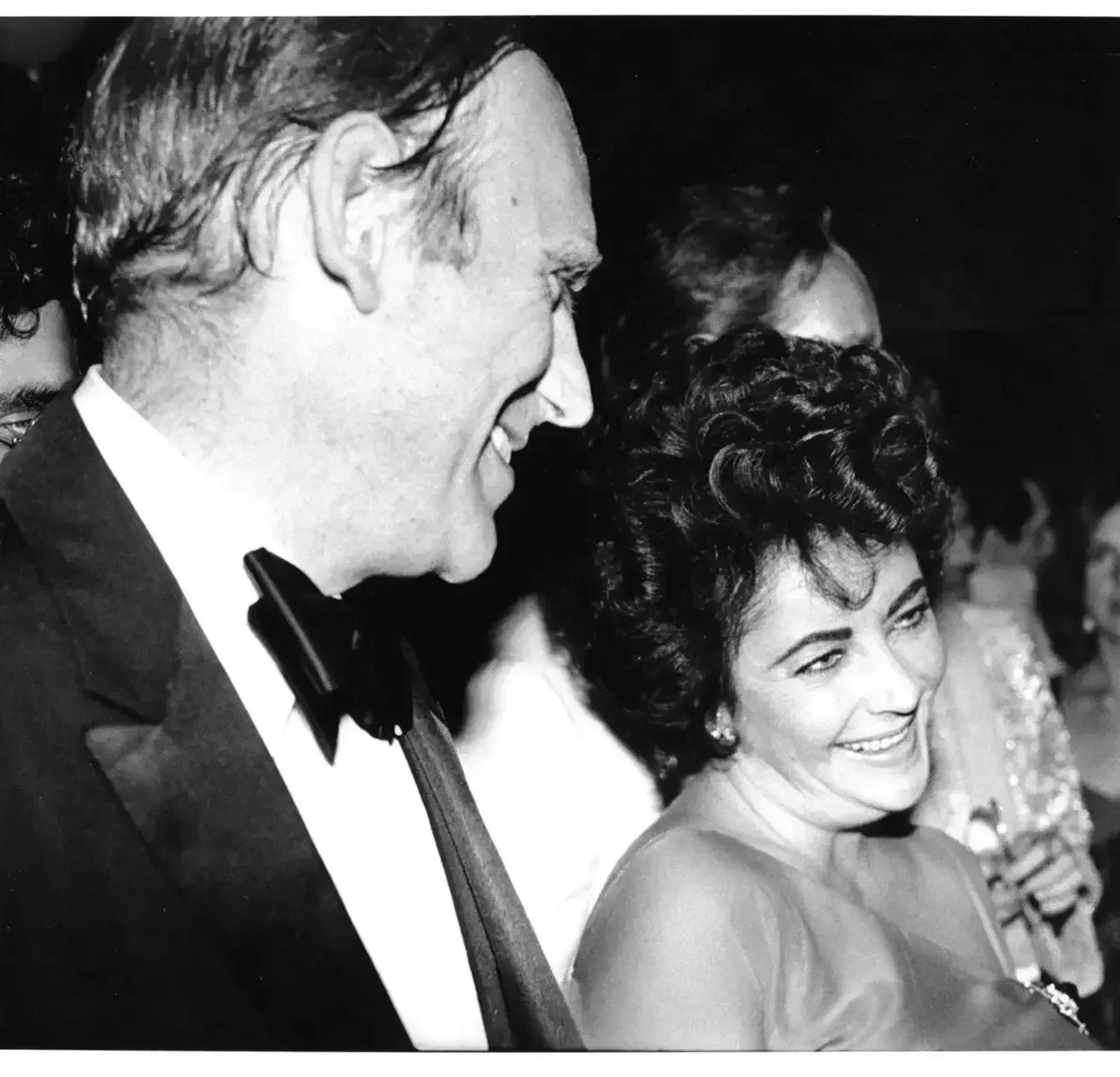
Richard Oldenberg & The Elite Orbit of Manhattan A distinguished collector and art world power broker, Richard Oldenburg was a central figure, both personally and professionally, of the elite art and cultural orbit of Manhattan in the latter half of the 20th century. Born in Stockholm, Sweden, Richard Oldenburg and his older brother, the famed Pop artist Claes Oldenburg, spent their earliest childhood years in Sweden, before moving to Chicago in 1936, when their father Gösta was named the city’s Swedish Consul General. Their mother, the former Sigrid Lindforss, was accomplished in her own right, having enjoyed a career in Sweden as an opera singer and, later, as an abstract painter. Career Success The two Oldenburg brothers would themselves go on to have careers of significant influence within the art world, though their paths would take quite different turns. After a tenure at Harvard Law School and time spent in military service, Richard embarked upon a career in book publishing at Doubleday and MacMillan. With Claes an emerging presence in the growing Pop Art scene, however, the art world was always close at hand. As Richard recalled in the Museum of Modern Art’s oral history, “through [Claes], I met Rauschenberg, Lichtenstein, Warhol, Segal, Rosenquist—everyone—because they were all in very close contact. It was a very exciting time. It was the whole emergence of the Pop Art movement.” Indeed, it was after a fortuitous meeting with a former colleague at the opening of Claes’s 1969 MoMA exhibition that Richard assumed the role of Director of Publications at the museum. So successful was he in his post that soon thereafter he was appointed MoMA's Director, a position he would hold from 1972 until 1994. The Cornerstones of the Art World Once Richard joined the museum, the two brothers were cornerstones of the art world: one creative, the other practical. Richard’s unique talents allowed him to thrive in his role as a cultural chief executive. Under his stewardship, the museum made tremendous strides, including an expansion that saw its exhibition space more than double, a transformative change for one of the world's leading institutions. Upon his retirement from the museum in 1994, Richard joined Sotheby’s, where he served as Chairman of North and South America until 2000. Richard’s interest in art extended far beyond the professional and he built an impressive personal collection of international scope. Across several sales in 2019, Freeman’s offered a selection of works from the Collection of Mr. and Mrs. Richard E. Oldenburg; notable among these pieces were works by Mimmo Rotella, Roy Lichtenstein, Ellsworth Kelly, and, of course, Claes Oldenburg.
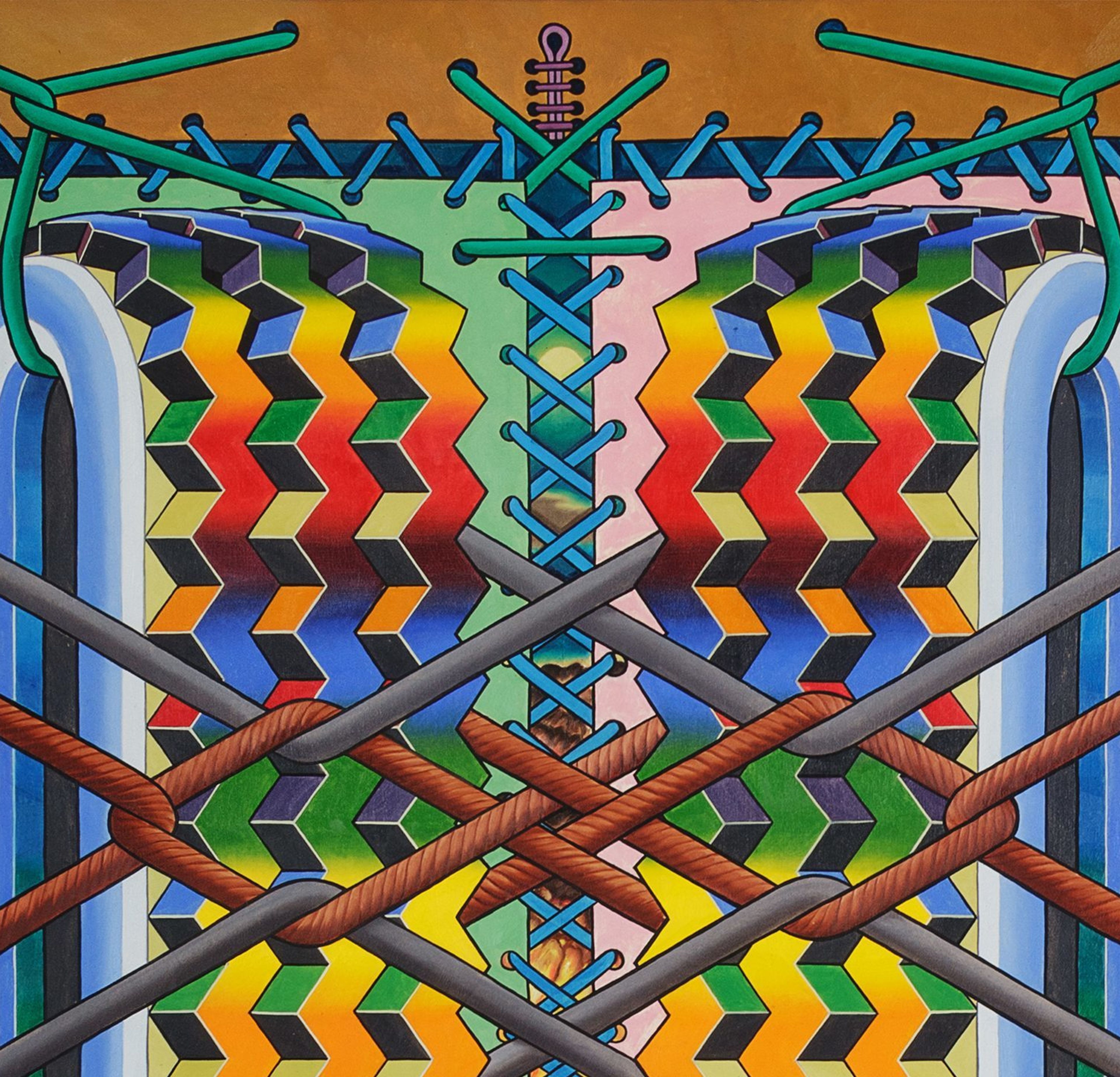
Hindman’s September 26 Post War and Contemporary Art sale realized over $3.4 million and was led by an extraordinary session of rare and outstanding paintings by the Hairy Who? and the Chicago Imagists that surpassed presale estimates and broke four global auction records. This session included the top selling lot of the sale, Jim Nutt’s Plume, which realized $516,500 against a presale estimate of $200,000- $400,000. The painting broke a global record, being the most expensive work ever sold at auction by the artist. Other Chicago Imagists realizing global records include Gladys Nilsson, Karl Wirsum, and Art Green. Gladys Nilsson’s Dipdick…Adam and Eve after Cranach shattered expectations realizing $324,500 against a presale estimate of $20,000-$30,000. Karl Wirsum’s Doggerel III realized over triple its high estimate, selling for $212,500. Guarded Irregularities by Art Green, sold for almost double its presale estimate, realizing $45,000. Zack Wirsum, Senior Specialist of Post War and Contemporary Art, stated: “We are absolutely over the moon about the prices that the works by Hairy Who? and Chicago Imagists brought today. To be in a position to continue to set new precedents for the auction prices of these artists fills us with hometown pride. The entire auction was gangbusters with the majority of the lots offered selling above or towards the high end of the estimate, it was a truly phenomenal day in the Hindman salesroom.” More highlights from the sale include Larry Poon’s Untitled, which carried a presale estimate of $30,000 – $50,000 and sold for $131,250 and Personajes con Pajaro Negro by Wifredo Lam which realized $200,000 against a presale estimate of $40,000- $60,000. The Post War and Contemporary Art sale was immediately followed by Hindman’s Prints and Multiples auction, which was led by a strong session of Alexander Calder lithographs from the Terrance J. Dimoff Charitable Remainder Trust. This rare group realized $89,250, exceeding the high estimate for the collection. Additional highlights of the Prints and Multiples auction include Helen Frankenthaler’s Tales of Genji I which sold for $57,500 against an estimate of $30,000-$50,000 and a pair of Frank Stella relief collages which sold for $11,875 and $11,250 respectively. The Pop Session included a Roy Lichtenstein’s Crak! which sold for $15,000.
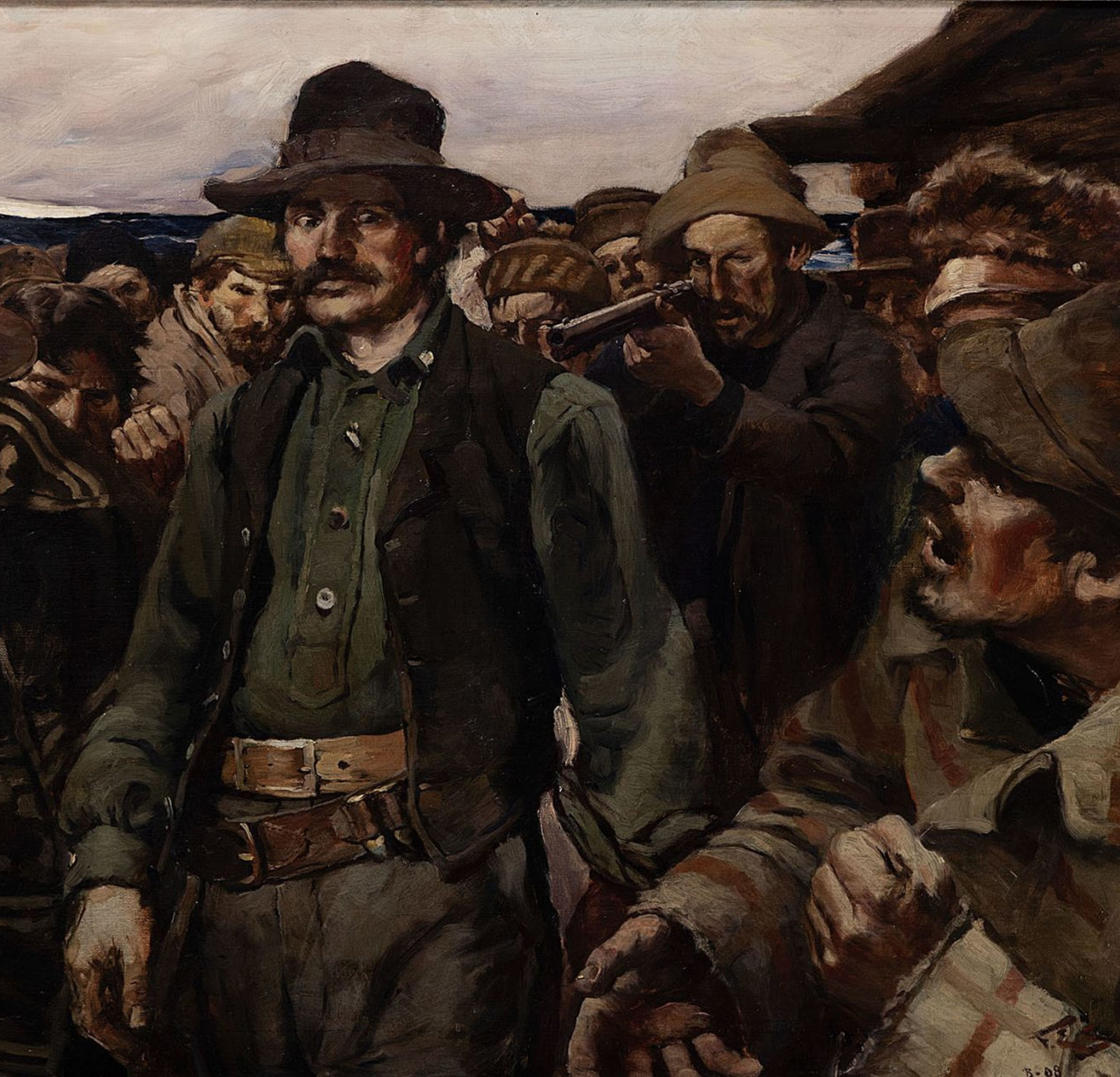
On October 10, 2019, Cowan’s will offer the collection of James B. Scoville in a single-owner auction at its Cincinnati salesroom. The spectacular collection offers perhaps the most complete snapshot of the latter half of the 19th century in the Great Plains of the United States. Across over 200 lots, the collection manages to seamlessly blend majestic Western art depicting the legend of the region with artifacts that provide a record of the realities of life for Native Americans at the time. “I’m not sure you could have assembled a better representation of the Great Plains in the 19th century if you had unlimited time and resources,” said Danica Farnand, Cowan’s director of American Indian & Western Art. “James’ fervent passion and incredible eye for quality created one of the most extraordinary collections we’ve ever had the pleasure of handling.” Born in Riverside, Ill. in 1924, Scoville was an outdoorsman from the earliest days of his childhood. He and his wife, Peggy, were avid hunters traveling the Great Plains to bow hunt, camping in their canvas replica teepee, in pursuit of deer, elk, and antelope often on horseback. A lifelong naturalist, he was a founding Director of Citizens for Conservation in his hometown of Barrington, Ill. This love of the outdoors sparked a passion of the history of the region, particularly in the 19th century. Scoville expressed this passion by meticulously curating a collection that could best depict that history. “James was an incredible storyteller,” said Farnand. “In his collection, he’s telling us the story of the Great Plains. These majestic Western Art pieces of sweeping landscapes, untamed wildlife, and the rough and tumble frontiersmen show the romanticized legend of the Plains. Understanding the legend is critical to putting the reality of history into context.” The top Western Art lot is expected to be a C. M. Russell (American, 1864-1926) watercolor over pen and ink on paper entitled Inspection of a Permit. Russell, was one of the finest artists produced by the American West. Born in St. Louis, Russell became fascinated with the West as a young boy and began filling his notebooks with sketches of Native Americans and cowboys. Adding to the value of this particular watercolor, is a hand-written inscription along the lower margin believed to indicate the piece was a personal gift to a friend. The lot is estimated to sell for $80,000 to $100,000. Other Western Art highlights include a WHD Koerner (German, 1878-1938) oil on canvas entitled Two Men in a Canoe, estimated to sell for $20,000 to $30,000; a Harvey Dunn (American, 1884-1952) oil on canvas entitled A Journey in the Badlands for $15,000 to $25,000; another C. M. Russell work, this one pen and ink with color on paper, entitled Looking for Trouble for $15,000 to $25,000; and a Frank Schoonover (American, 1877-1972) oil on canvas for $10,000 to $15,000. Highlights from the artifact portion of the auction include a vividly colored Cheyenne River Sioux pictorial beaded hide tobacco bag expected to sell for $30,000 to $50,000; an early plains pictorial beaded knife sheath with knife for $20,000 to $30,000; a Sioux quilled and beaded buffalo hide bowcase and quiver for $20,000 to $30,000; and a brightly colored Crow beaded hide rifle scabbard for $15,000 to $25,000. The auction will take place on Thursday, October 10 at 10:00 a.m. (ET) in Cowan’s Cincinnati salesroom.
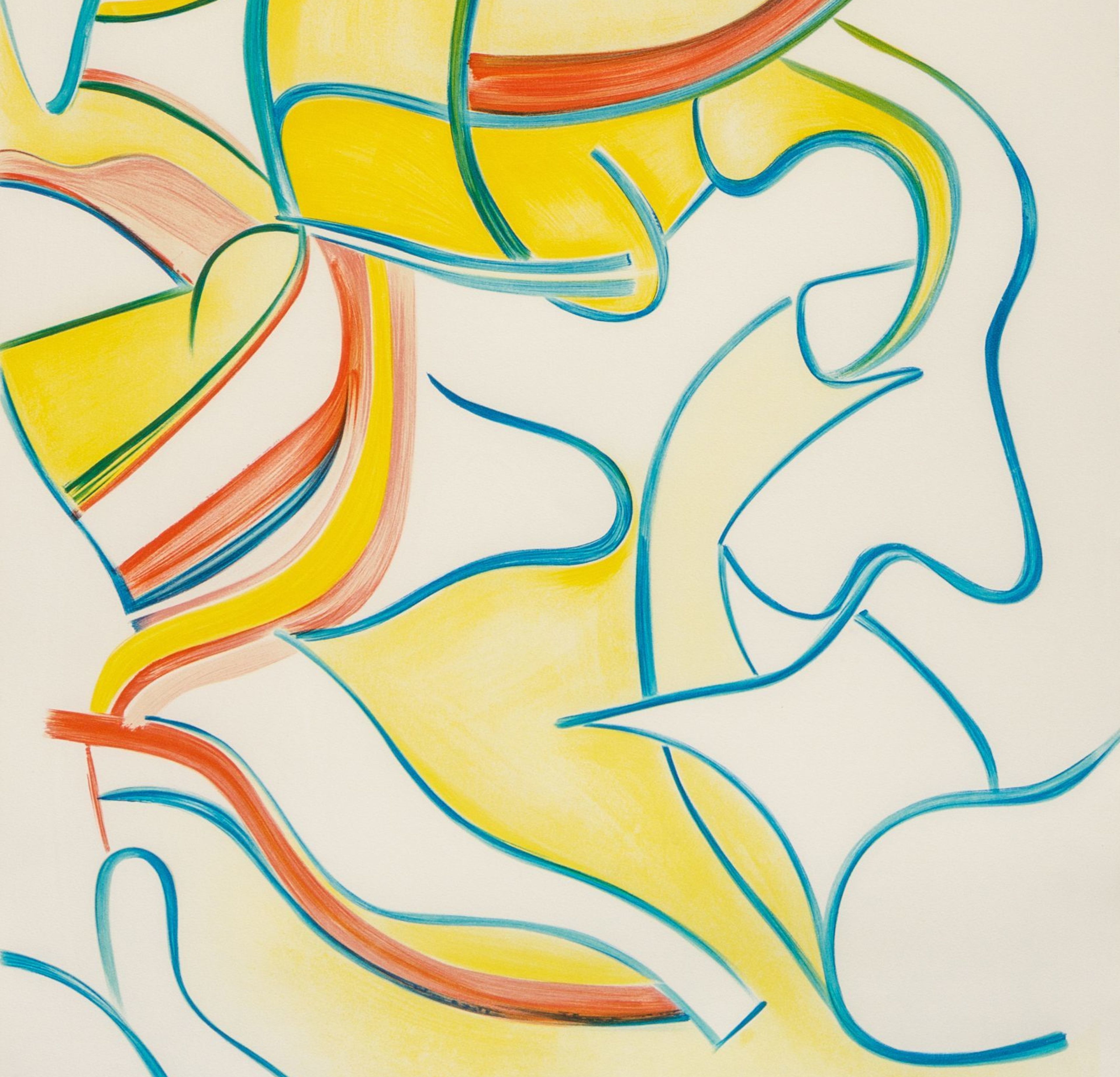
“Later, as I get older, it is such a nice thing to see a nice Matisse…When people say my later paintings are like Matisse, I say, ‘You don’t say,’ and I’m very flattered.” -Willem de Kooning, quoted in R. Storr, “At Last Light”, Willem de Kooning, the Late Paintings, the 1980s, New York, 1995, p. 71 A giant of Post War painting and a founder of Abstract Expressionism, Willem de Kooning had the inimitable ability to continually develop and refine his style over the course of his 60 year career. Unlike many of his contemporaries, his final style was lyrical and sinuous, bright and primary, deliberate and exacting. Quatre Lithographies embodies the primary color palette and pure reductive forms of this late style. For de Kooning, the 1980’s heralded a period of prolific output but also of renewed focus and clear thinking. Coming out of a decade of dark and self destructive behavior, by 1981 he was living full time in East Hampton with his ex-wife, Elaine de Kooning. Newly sober and surrounded by close friends and assistants, he began to paint again with his former exuberance. His studio at this time featured a new type of easel, devised by Elaine’s brother, that could rotate paintings 360 degrees and raise and lower them easily so that he could work on all parts of a canvas at once. This process helped imbue his late works with a sense of consistency that transforms itself into movement as the viewer’s eye travels throughout the composition. This lightness and movement is clearly reminiscent of the works of Henri Matisse, whom de Kooning clearly identified with late in his life. In 1980, he stated “Lately I’ve been thinking that it would be nice to be influenced by Matisse, I mean he’s so lighthearted. I have a book about how he was old and he cut out colored patterns and he made it so joyous. I would like to do that, too–not like him, but joyous, more or less ” (Willem de Kooning, quoted in M. Stevens and A. Swann, de Kooning: An American Master, New York, 2004, p. 589). He soon made the joyous, lyrical and sinuous lines of Matisse a part of his vernacular. Quatre Lithographies, published in 1986 by the French publisher Éditions de la Différence, embodies each element of this late style. You can feel the consistency imparted by the mechanical easel, the lightness of Matisse, the newfound sobriety and poignancy of form. Published as a portfolio of four in an edition of 150 (50 numbered in Roman numerals) this set is rarely seen complete. Of the very few lithographs created by de Kooning late in his career, this set is unequivocally the most finished, complete and visually engaging. It is easily the crowning achievement of the graphic works of Willem de Kooning. Available in Hindman’s September 26 Prints and Multiples auction, Quatre Lithographies is estimated at $80,000- $120,000. The auction will be conducted in the Chicago sale room at 2pm CT.
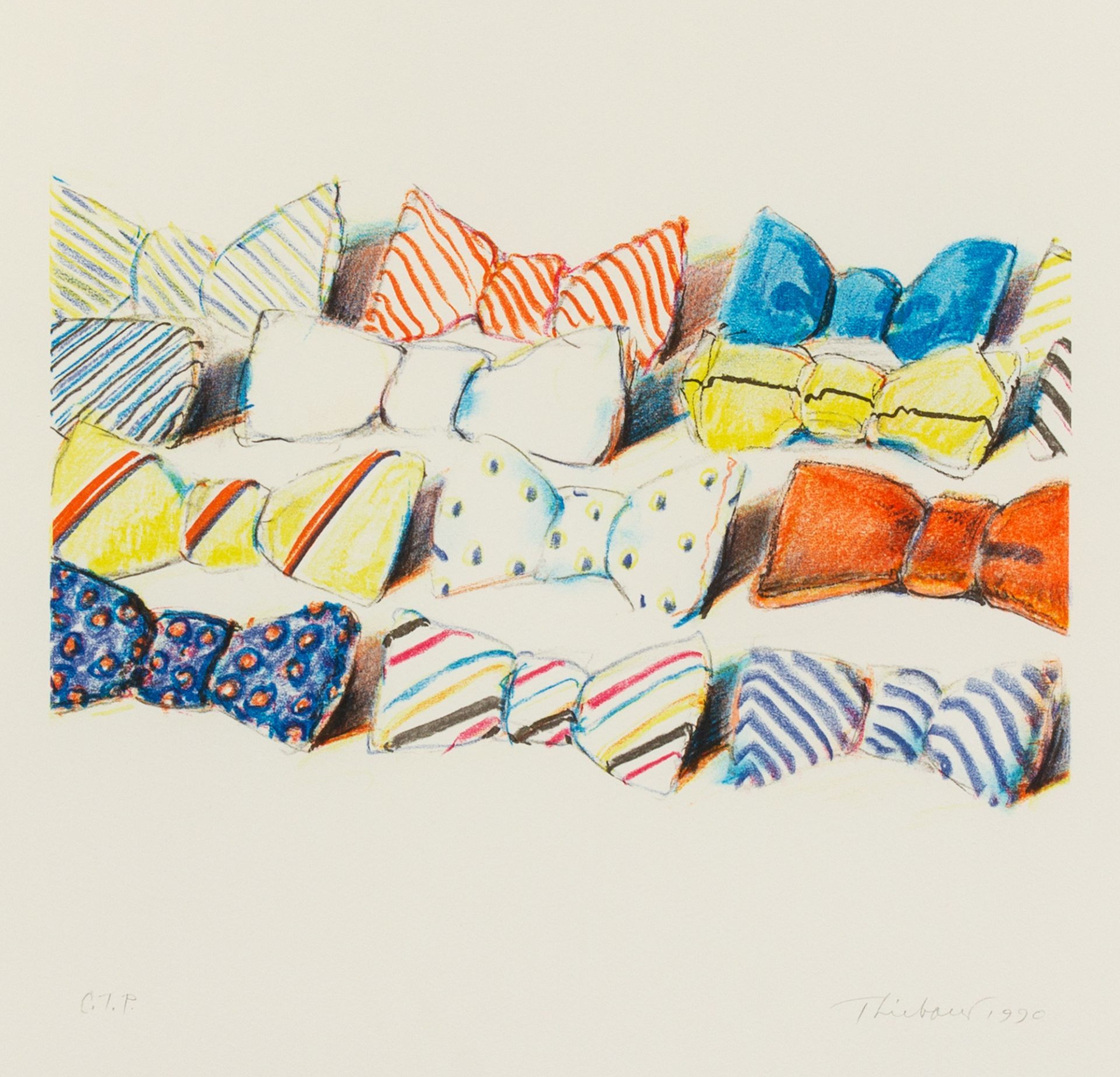
Prolific American painter and print maker Wayne Thiebaud is perhaps best known for his colorful, heavily-pigmented works depicting everyday objects including lipstick, paint cans and gumball machines. Associated with the pop art movement alongside contemporaries including Andy Warhol and Roy Lichtenstein, Thiebaud’s work actually predated classic pop artists. Born to a Mormon family in Mesa, Arizona, Thiebaud spent his adolescence in Long Beach, California. After working as a drawing apprentice at Walt Disney Studios, he attended Frank Wiggins Trade School in Los Angeles before working as a cartoonist and designer in California and New York. He later earned his bachelor’s degree from Sacramento State College in 1951 and his Master’s in 1952. Working as a professor at the University of California, Davis, Thibaud took a leave of absence in the late 1950’s, spending time in New York City where he befriended Elaine and Willem de Kooning and Franz Kline, leading to a heavy abstract influence in his work, as well as pop artists Robert Rauschenberg and Jasper Johns. Hosting his first solo exhibition in 1960 at the San Francisco Museum of Modern Art, he also enjoyed shows in New York City before gaining national recognition when Sidney Janis Gallery launched Pop Art in 1962. Well-known for his vibrant paintings and prints of everyday objects, Thiebaud often drew inspiration from items found in restaurants. Though Thiebaud never thought of himself as a “pop artist,” he often found his work displayed alongside the major pop artists of the day. One of his iconic works, Bow Ties (1990) is a lithograph in colors on wove paper, signed, inscribed and dated in pencil. The piece, depicting colorful bow ties in the artist’s signature exaggerated color scheme, Thiebaud uses shadow and space to create depth and contrast in the image. Available as the featured piece in Hindman’s upcoming Prints and Multiples sale, Bow Ties (1990) by Wayne Thiebaud is valued at $20,000 to $30,000. The sale will take place on Wednesday, May 22 at 2 p.m. at Hindman’s Chicago headquarters, with the catalog available for preview now.
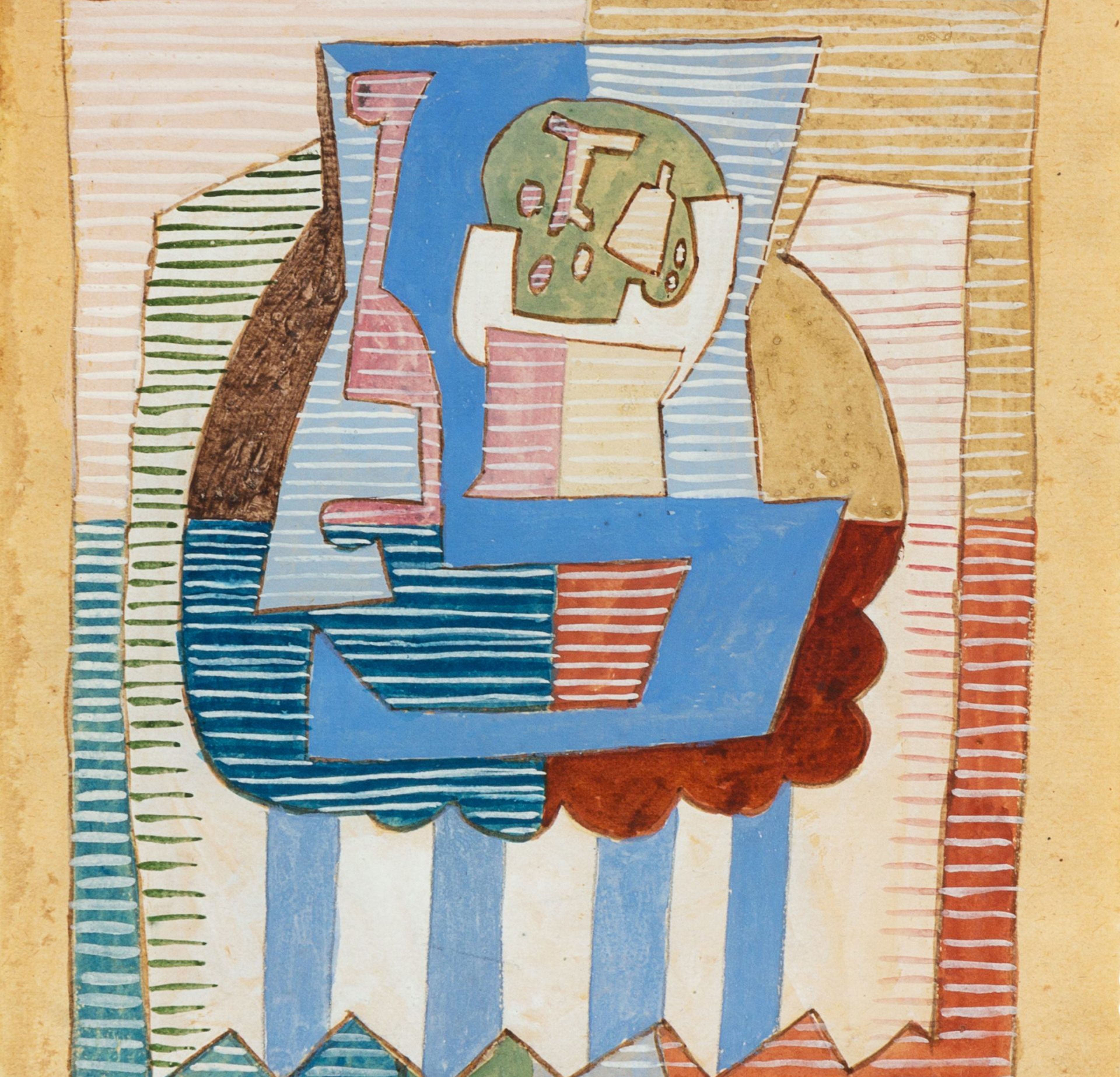
The 1920s was a period of personal contentment and artistic satisfaction for Pablo Picasso, a fresh beginning after the chaos of WWI. With a new home and studio in a chic Parisian arrondissement, Picasso’s days as a starving artist were behind him, and, as the decade progressed, his work and reputation grew exponentially. Stylistically during this time, Picasso vacillated between the two commanding yet fundamentally different artistic movements popular in avant-garde Paris: Cubism and Neo-Classicism. Picasso seamlessly switched between these styles, consistently confronting expectations and this flexibility and mastery of both genres allowed him to maintain his position as one of the leading characters in the story modern art. Picasso feverishly worked on dozens of small format gouache works during this time period and each are crucial to understanding the gradual progression from the artist’s purely abstract Cubist art to more neoclassical compositions that characterized the 1920s. On an intimate scale in the present work, Picasso continues to explore new ways to infuse configurations of everyday life with the impression of volume in from a flat space. The striated lines emphasize the figures in the forefront of the image creating depth and dimension. As friend and biographer John Richardson noted in his book, Picasso, An American Tribute, “No longer did Picasso feel obligated to investigate the intricate formal and spatial problems that preoccupied him ten years before. Instead he felt free to relax and exploit his cubist discoveries in a decorative manner that delights the eye…Never again did the artist’s style recapture the air of magisterial calm that is such a feature of this last great phase of Cubism,” (p. 52). A highlight in Hindman’s upcoming American and European Art sale, Abstract Composition (1920) by Pablo Picasso comes from a private Chicago estate and is valued at $200,000 to $400,000. The sale will take place on Thursday, May 23 at 10 a.m. at Hindman’s Chicago headquarters, with the catalog now available online for preview.
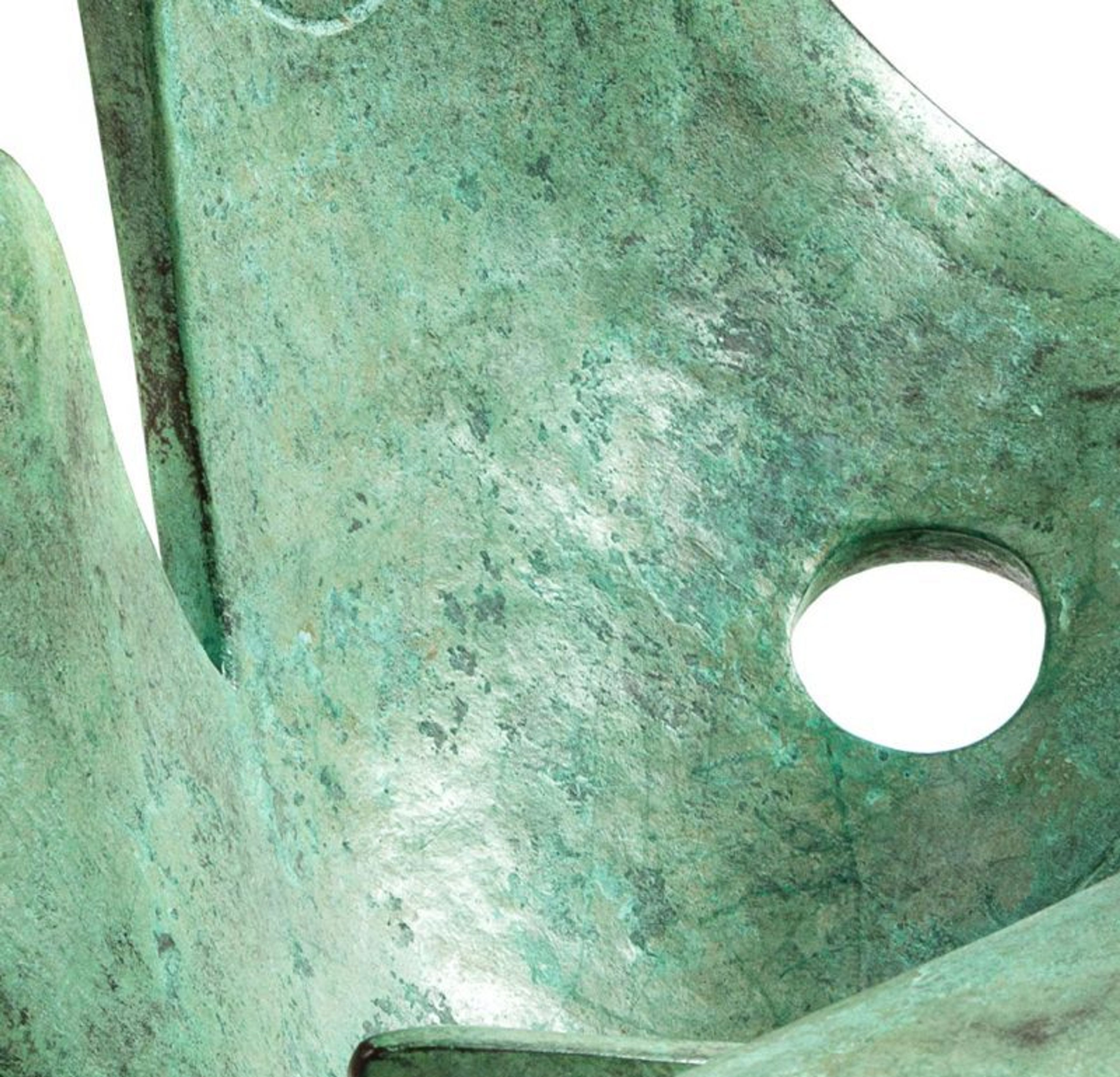
A pioneer in the Modernism movement, English artist and sculptor Dame Barbara Hepworth was one of the few female artists of her generation to rise to international acclaim. She was also a leading figure in the St. Ives artist colony during World War II, along with contemporaries such as Ben Nicholson and Naum Gabo. Born in Wakefield, Hepworth attended the Royal College of Art in London before traveling to Florence, Italy. After training under master sculptor Giovanni Ardini, she returned to London to exhibit her early work alongside then-husband and fellow sculptor John Skeaping. Her early work was shaped by abstraction, eventually leading her to involvement with the Paris-based Abstraction-Création movement. She also co-founded the Unite One art movement, seeking to unite Surrealism and abstraction in the British art world. At the outbreak of the Second World war in 1939, Hepworth, her second husband Ben Nicholson, and their children went to live in Cornwall. Finding her home in Trewyn Studios, she helped usher in St. Ives as a refuge for artists during the war. Co-founding the Penwish Society of Arts with nineteen, Hepworth created works that were exhibited in the British Pavilion at the XXV Venice Biennale in 1950. Today, Hepworth’s name graces two museums housing significant collections of her work in Cornwall and West Yorkshire, and pieces are on display around the world, from London, to New Zealand, to Northwestern University in Evanston. One of several pieces inspired by time spent in the Aegean Islands following the death of her eldest son Paul in 1953, Aegean (1956) is a bronze sculpture measuring at 11 x 9 x 11 inches. Obtained from a private collection in St. Louis, Aegean has been in private hands since 1962, making this the first time this piece has been available in more than 50 years. Available as the featured piece in Hindman’s upcoming Post War and Contemporary Art sale, Aegean (1956) by Barbara Hepworth is estimated at $100,000 to $150,000. The sale will take place on Wednesday, May 22 at 10 a.m. at Hindman’s Chicago headquarters, with the catalog available for preview now.
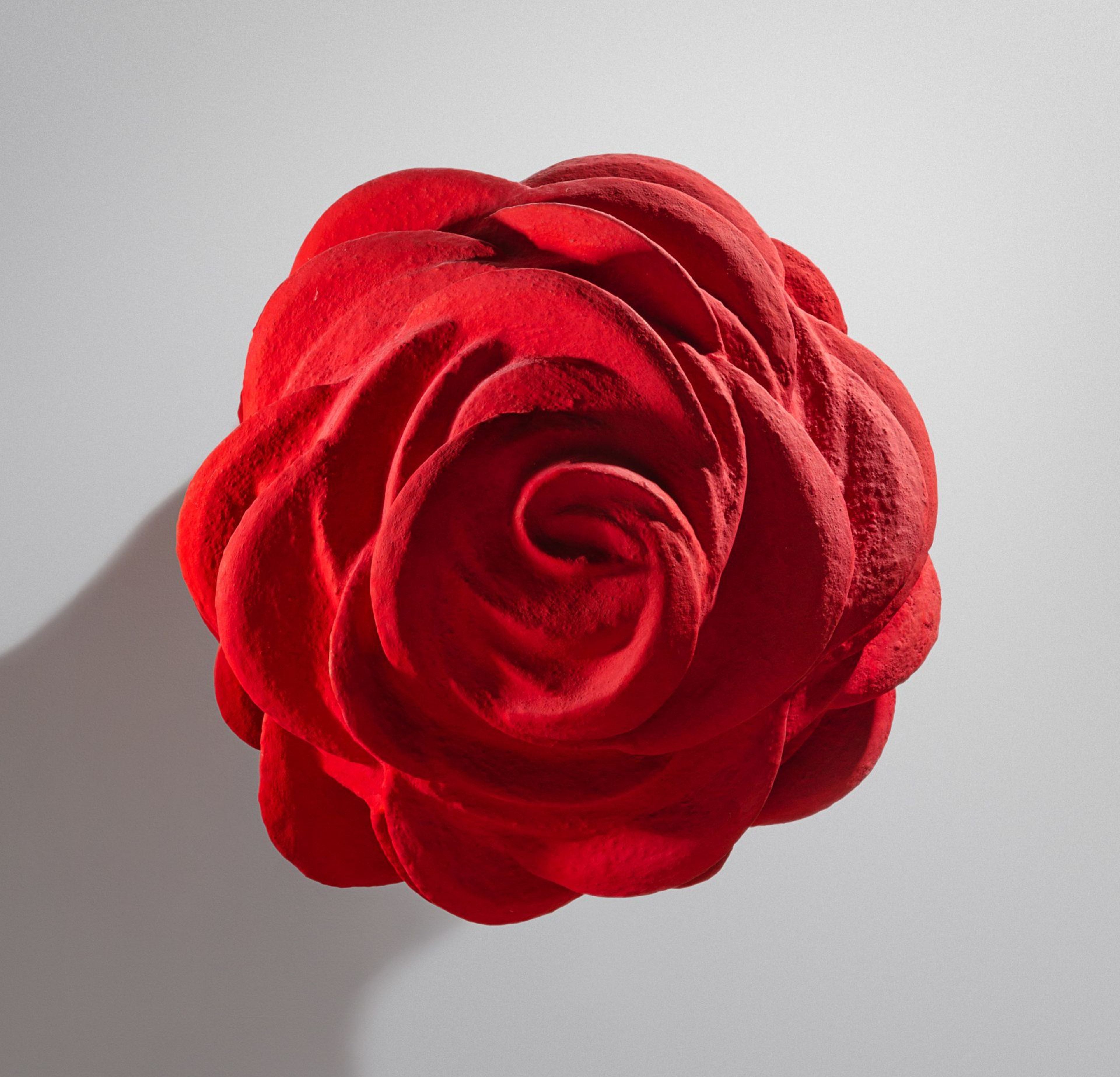
Bombay, India-born sculptor Anish Kapoor burst onto the art scene in the 1980’s with his striking geometric or biomorphic sculptures created from simple materials including plaster, granite, limestone and marble. Perhaps best known locally for his Cloud Gate (2006)sculpture, better known as “The Bean” in Chicago’s Millennium Park, Kapoor has worked primarily with polished stainless steel since 1995. Often recognized for his explorations of matter and non-matter, Kapoor’s designs use negative space and diverse materials to create the illusion that they are fading into the distance, sinking into the floor or distorting the space around them. According to Kapoor, “That’s what I’m interested in: the void, the moment when it isn’t a hole. It is a space full of what isn’t there.” World-renowned and often celebrated, he was the first Guest Artistic Director of the UK’s Brighton Festival and the first living artist to have a solo exhibition at the Royal Academy of the Arts. A resident of London, Kapoor’s works are held in collections around the world, including The Museum of Modern Art in New York City, the National Gallery of Art in Washington, D.C., the Tate Gallery in London and more. His first major body of work, called From 1000 Names to signify the objects’ infinite interconnectivity, features deeply pigmented powder works that sit on the floor or project from a wall, defining the surfaces they interact with and appearing to be partially submerged. Untitled from 1000 Names, (1984), imbued with a deep kumkuma red, captures the complexities and compelling contradictions of Kapoor’s seminal sculptural series. From a head-on vantage point, the work appears superficially floral but morphs into a vital feminine physicality when viewed at length. In profile, the work protrudes from or penetrates into the wall, cleverly opposing the enveloping front angle while the piece’s curved contours convey the motion and carriage of a drill bit. An artistic interpretation of powerful male and female properties, the piece speaks to the notion of godliness, demonstrating the possibility of omnipotence – the state of being all things at once. Simultaneously demanding reverence and invoking a sense of magic, the piece seems to levitate in a bold defiance of the physical world in which is resides. Untitled from 1000 Names (1984) by Anish Kapoor is available in Hindman’s upcoming Post War and Contemporary Art sale. The sale will take place on Wednesday, May 22 at 10 a.m. CST at Hindman’s Chicago headquarters.
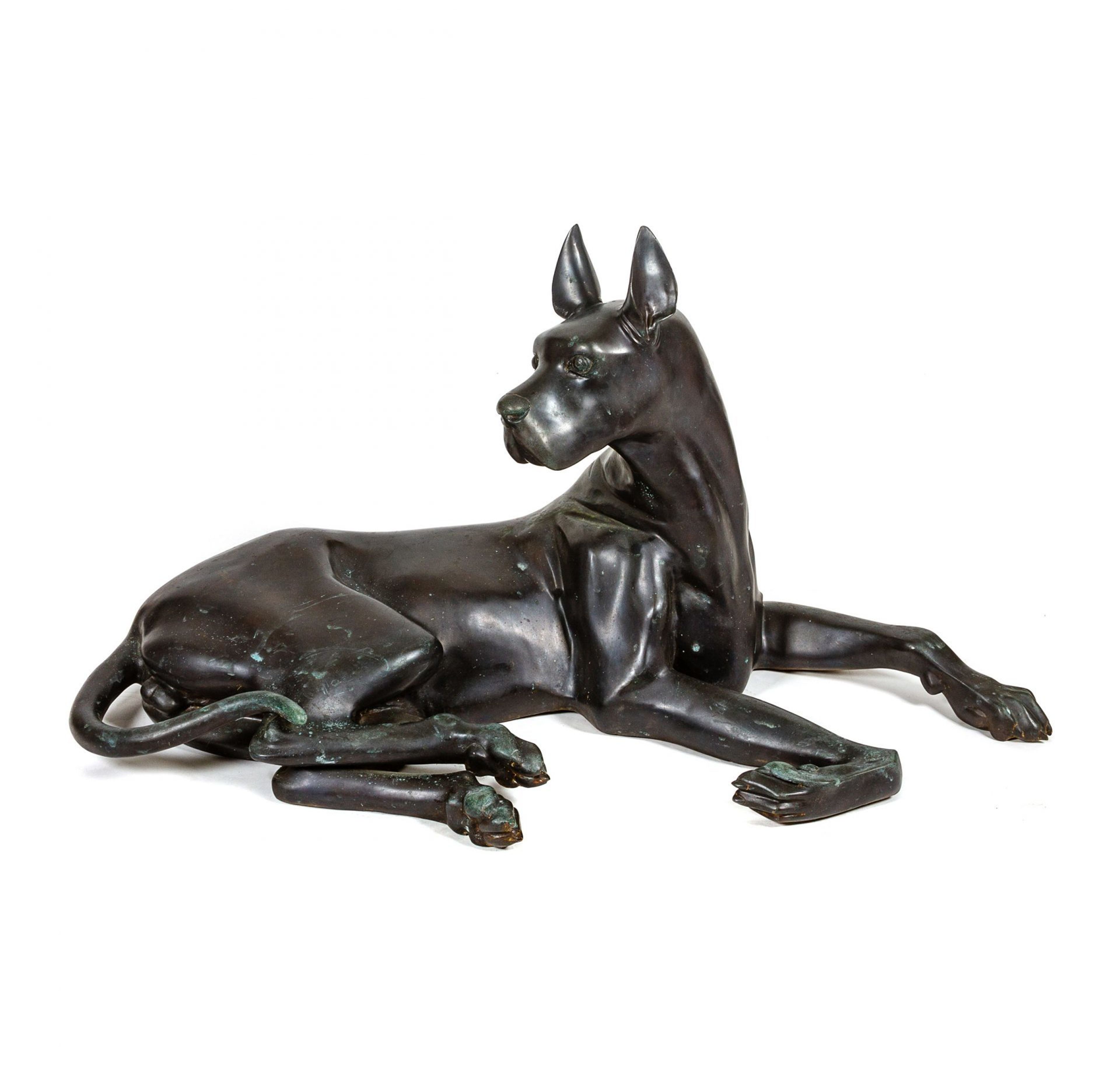
After 30 years in St. Louis, the American Kennel Club’s Museum of the Dog has moved to New York. A selection of items from their collection will be offered in our St. Louis Spring Auction on April 23. This selection includes works in a wide variety of media with over 80 breeds represented. Continue reading to discover highlights from the delightful collection. LOT 283 | A Royal Doulton Flambe Bulldog A striking flambe glaze covers the entirety of this figure. Royal Doulton began producing figures with flambe glazes in 1904, and a series of flambe animals in 1908. This bulldog is one example, with its vibrant red hue and relaxed seated posture. LOT 403 | A Large Bronze Great Dane Sculpture This life-size sculpture embodies the naturally statuesque Great Dane. With its head raised, it glances to the right, creating tension and suggesting a narrative. Perhaps it just heard its name or keys in the door as its owner returns home after a long day. LOT 461 | A Painting Depicting a Mastiff. After Anthony van Dyck (Belgian, 1599-1641) a copy of “The Five Eldest Children of Charles I,” oil on canvas The charming Mastiff depicted here appears to be the perfect family dog, as the eldest son rests his arm on its head. Seated in the center of the composition, it is clear that this dog was an important member of the family. Personalities of the two dogs pictured are visible, as the smaller dog in the lower right vies for the same attention as his larger counterpart. LOT 493 | A Wood and Marble Dog House Among the most whimsical items of the collection is this dog house with real marble floors. It has an elaborately painted interior and exterior that make it truly fit for royalty. Scottish Terriers stand atop the roof like guardian figures for the lucky dog that sleeps here.
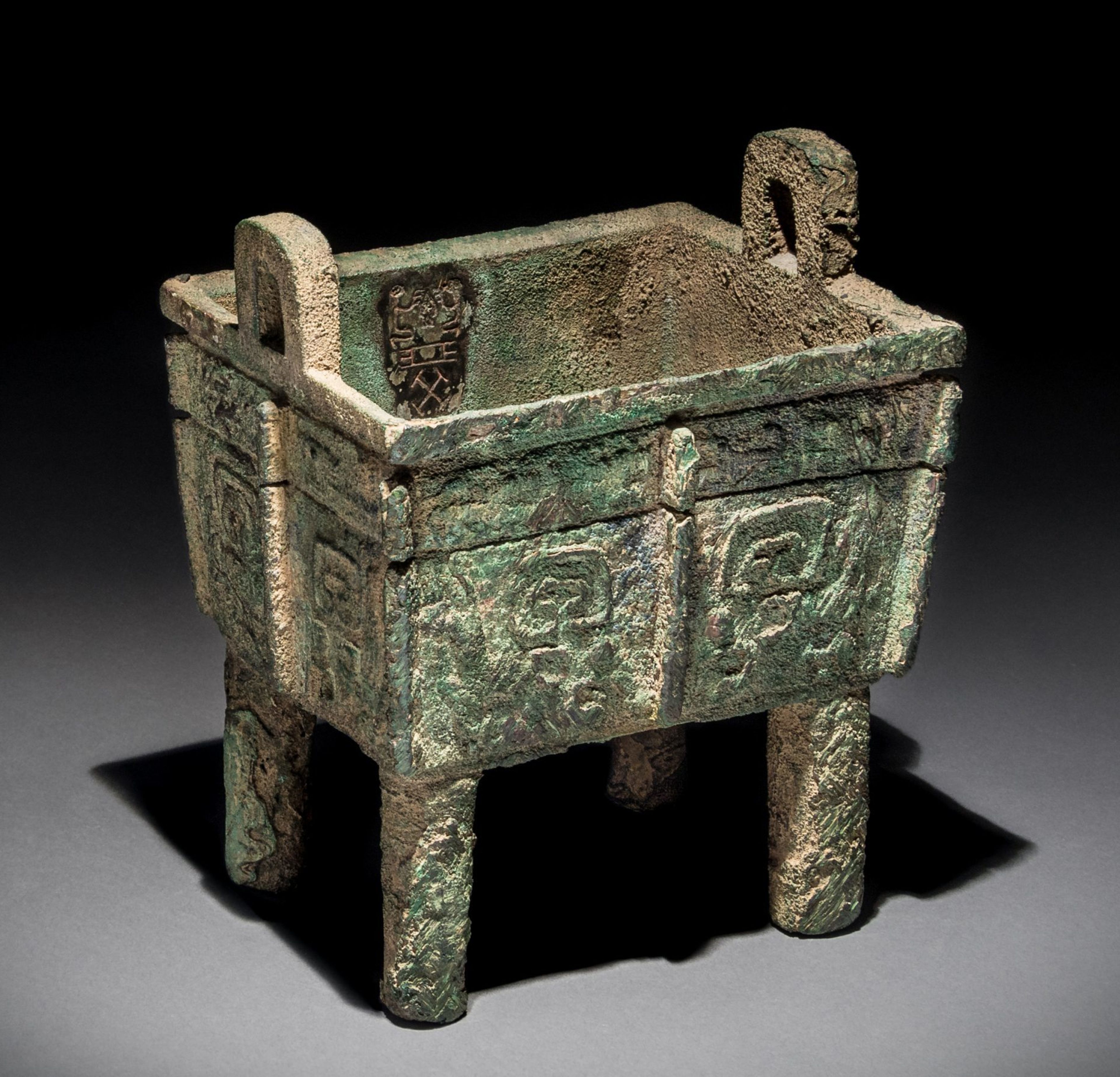
Our auction of Asian Works of Art returns on March 25 sale with six outstanding examples of Chinese secular and religious art history spanning two millennia. Continue reading to learn more about these ancient objects and their histories. LOT 135 | A RARE BRONZE RITUAL FOOD VESSEL, FANGDING LATE SHANG DYNASTY (12TH-11TH CENTURY B.C.) 商晚期 青铜饕餮纹方鼎 The rectangular body of this vessel rises atop four stout cylindrical legs and is surmounted by a pair of upright loop handles. Exaggerated flanges extend from its walls and demarcate taotie masks against a ground of thundering clouds. One interior wall features a cast inscription of two kneeling figures flanking a ritual vessel, all above a gui character. The vessel and its inscription are illustrated in Robert Bagley’s authoritative text on Chinese ritual bronzes, Shang Ritual Bronzes in the Arthur M. Sackler Collections, Robert W. Bagley, The Arthur M. Sackler Foundation, 1987, which will be included in this offering. 直壁槽型,雙立耳,四柱足,口唇折沿。頸飾夔紋,腹以雲雷紋填底飾大獸面紋。鼎身四隅和四面中部均起扉棱。內壁有簡式祭辭銘文“亞父癸”。器表發棕銹,間露綠銹,古意盎然。賽克勒上世紀中葉購得此鼎,收錄于白格利為其撰寫的青銅器圖錄第一輯,編號88。此書將隨鼎受予成功競拍的買家。 Provenance來源: Fine Chinese Ceramics and Works of Art, Including Property from the Arthur M. Sackler Collections, Christie’s New York, March 25-26, 2010, sale 2405/2297, lot 1003 紐約佳士得中國工藝精品專場,2010.3.25-26,1003號拍品 Literature著錄: R.W. Bagley, Shang Ritual Bronzes in the Arthur M. Sackler Collections, The Arthur M. Sackler Foundation, 1987, pp. 472-5. no. 88 羅伯特·白格利《亞瑟·賽克勒藏青銅器》472-475頁88號 N. Barnard and Cheung Kwong-yue, Rubbings and Hand Copies of Bronze Inscriptions in Chinese, Japanese, European, American and Australasian Collections, Taipei, 1978, no. 1300 (inscriptions only) 巴納、張光裕主編《中日歐美澳紐所見所拓所摹金文彙編》1300號 LOT 136 | AN ARCHAIC COVERED WINE VESSEL, HE EASTERN ZHOU DYNASTY, WARRING STATE PERIOD (475-221 B.C.) 东周 战国 青銅弦紋盉 The compressed globular body of this vessel is nestled between a trio of squat cabriole legs, surmounted by a short neck and wide mouth, and decorated by a raised ring encircling its otherwise smooth surface. A molded mythical beast emerges open-mouthed from the body to form a side spout. The handle, terminating in two tiger masks grasping at the vessel, is further joined to the fitted cover by a chain of loose rings. 短颈广肩,有盖有流,肩上有梁,梁的两端雕有銜環的獸首,盖的中间附有銅環三枚,作鏈扣与提梁相连。盉腹渾厚而橫扁,当中凸起一道弦纹,下作三蹄足;上出鳥形流,竖耳圆口,双翼出廓,紋飾一絲不苟,與梁上鬚眉凸目的獸首相扣。盉身青綠,佈滿翡翠色的鏽斑,無銹處則露出濃郁的古銅色,交錯如大千潑彩墨。提梁久經摩挲,包漿瑩潤,棱線隱起,沉秀如砂器。 Provenance來源: Acquired from J.J. Lally & Co. Oriental Art, July 17, 2008 紐約藍理捷,2008.7.17 LOT 137 | AN ARCHAIC BRONZE RITUAL WINE VESSEL, TILIANGHU EASTERN HAN DYNASTY (25-220) 东汉 青铜活环提梁壶 Alternating bands incised lozenges, feathers, lappets, and leaves skate the surface of this vessel’s pear-shaped body; with one side decorated with deer running across the mouth rim. The vessel covered by a fitted lid, equally decorated. A dense chain link runs the sides and connects to a dense arching handle. 侈口長頸,鼓腹溜肩,圈足外撇。肩部設輔首銜環一對,口沿出環一對,兩組環鈕間套有“8”字活鏈,配合最上方雙龍銜環式弧形提梁,使壺蓋與器身連成一體。一側蓋沿刻有回首奔跑的小鹿,子母口上下對準,小鹿身首合併,壺與蓋方能嚴絲合縫。通體布滿紋飾,略經整飭,除鏽施蠟,輕敷色料,華麗周致。 Provenance 来源: Acquired from J.J. Lally & Co. Oriental Art, July 17th, 2008 紐約藍理捷,2008.7.17 Fine Chinese Ceramics and Works of Art, Sotheby’s New York, September 18, 2007, sale N08342 lot 179 紐約蘇富比中國工藝精品專場,2007.9.18,179號拍品 Acquired by the previous owner in the early 1990s 前藏家購自90年代初期 On the Japanese art market in the early 1980s 80年代出現於日本藝術市場 Exhibited 展覽: Hong Kong Museum of Art, 2001 – 2006 香港藝術館2001-2006 Min Chiu Society exhibition, 1999 – 2000 敏求精舍1999-2000 LOT 138 | A LARGE AND RARE BRONZE TRIPOD TUREEN AND LADLE TANG DYNASTY (618-907) 唐 青銅三足鍑配勺 Three curving cabriole legs elevate the spherical body of this tureen: and the vessel’s roundness is further emphasized by incised concentric rings encircling its domed shoulders. The handle of the ladle bears a mark of three interlocking rings and is terminated by a lotus bud finial. Both fit inside a bespoke Japanese wood box. 斂口短頸,通體光素,肩部鏨有幾道弦紋,底部探出踡曲有致的三足,將渾圓的胎體輕輕托起。舀水的長匙鍛打出挺勁的弧度,匙面出尖如同蓮瓣,长柄在末端陡折,雕成垂蓮苞式樣。匙柄一端鏨有小小的品字形三圈纹样,當為區別用途的記號。 Provenance 來源: Acquired from J.J. Lally & Co. Oriental Art, September 25, 2009 紐約藍理捷,2009.9.25 The Idemitsu Collection, Tokyo, Japan 東京出光美術館舊藏 LOT 143 | A PARCEL-GILT SILVER BOWL TANG DYNASTY (618-906) 唐 銀鎏金髹漆鏨花鳥高足碗 The rounded sides of this silver bowl feature a relief of mandarin ducks and geese in flight amongst grasses and floral sprays, which has been hammered from the interior with repoussé technique. The body is lightly covered in a slight layer of black lacquer and adorned with gilt highlights, and rests in a fitted wooden box. 銀質鎏金,撇口弧腹,高圈足,內髹漆。器表以極細密的魚子紋為地,鏨有鴛鴦、鴻雁與卷草,口沿與足底以蓮瓣收邊。 LOT 620 | A CARVED LIMESTONE TORSO OF BUDDHA NORTHERN QI DYNASTY (550-577) 北齊 石灰佛軀立像” This torso of a Buddha is depicted standing, with a finely carved garment draped closely over the contours of its body. 石灰石質地,白淨無瑕,堅硬細密。身形挺拔,後背平順。頸上與肘下佚失,原應施與願印與無畏印。薄衣貼體,紋飾流暢有型,風格洗練清麗。 Property from the Collection of Jane Davis Doggett, Hobe Sound, Florida 佛羅里達州Hobe Sound市Jane Davis Doggett女士收藏 Provenance 來源: Acquired from The Chinese Art Gallery, New York, New York, February 20, 2007 2007年2 月20日購自紐約The Chinese Art Gallery藝廊 Our Asian Works of Art sale is March 25. Browse the digital catalogue, view lots online and register to bid now.
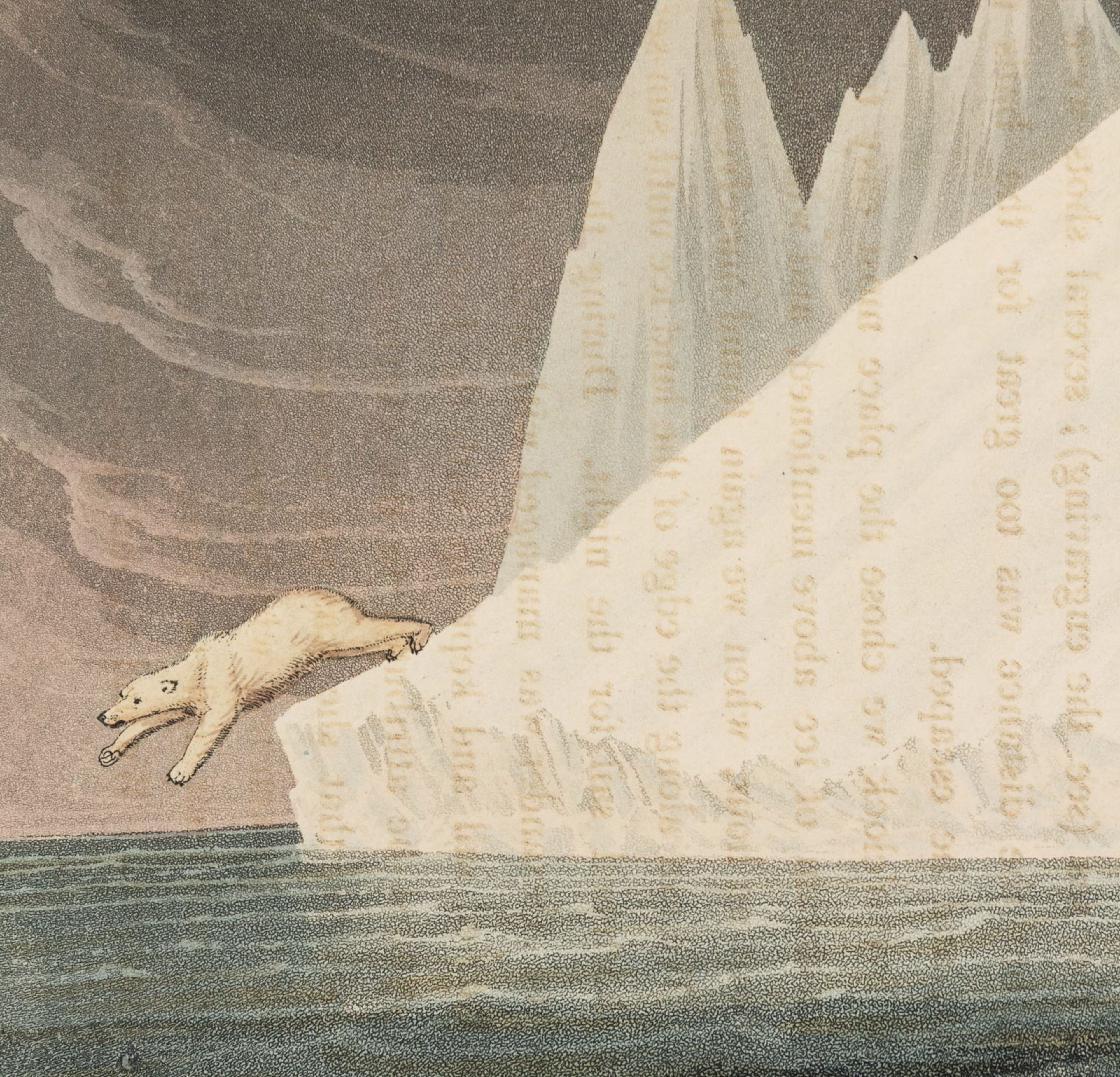
Better known for his adventurous pursuits in aeronautics, mountaineering, racing and boating, Steve Fossett was also a careful collector who built an exceptional library to reflect his personal interests. This second auction of his collection provides a final opportunity to own a piece from this epic adventurers’ personal library. Director and Senior Specialist of our Fine Books and Manuscripts department, Gretchen Hause, recounts Fossett’s life and selects notable items from the upcoming sale that represent his areas of interest. Steve Fossett held dozens of world records in numerous categories of speed and distance, and became known worldwide for his adventures in balloons, sailboats, and aircraft; he was also a fellow of the Royal Geographical Society and a member of the Explorers Club. He carefully compiled a library which was a reflection of his own pursuits. Each book had to fulfill one criteria: “Man’s willful determination to go beyond his borders and confines, and conventions, for science, adventure, gain, celebrity, or even out of sheer contrariness, by land, sea or air.” Fossett is perhaps best known for his aeronautical feats and accomplishments. In 2002, he became the first person to circle the globe, uninterrupted, in a balloon, a voyage which took 13 days, 8 hours, 33 minutes and which covered 20,626.48 statute miles. In February 2006, sponsored by the Virgin Group, Fossett completed the “ultimate flight,” piloting the Virgin GlobalFlyer for the longest uninterrupted and unrefueled aircraft flight in history, covering 25,766 miles. His library includes some of the most important books describing the history of aeronautics and aviation. Faujas de Saint-Fond’s work describing the first aerial voyage, completed by Montgolfier in June of 1783, is the first contemporary chronical of the voyage, and the first serious treatise on aerostation as a practical possibility (Lot 6). The library also includes a treatise by Dr. John Jeffries, considered the first American to fly (Lot 10). Steve Fossett broke records of speed and distance as a sailor and was one of the sport’s most prolific distance record holders; he was recognized by the World Sailing Speed Record Council as the “world’s most accomplished speed sailor.” Between 1993 and 2004, he set 23 official world records and 9 distance race records. In early 2004, Fossett and his crew of 13 set the around the world sailing record of 58 days, 9 hours. He collected works in the fields of circumnavigation and yachting, including 18th– and early 19th-century accounts of voyages around Australasia, the Pacific Northwest, and the Arctic. His library also includes landmark works about voyages by sea devoted to the discovery of the Northwest Passage and the North Pole. Sir John Ross described his first attempt to discover the North West Passage in A Voyage of Discovery… published in 1819. (Lot 121) Nearly 50 years before Ross’s first voyage, Baron Mulgrave Constantine John Phipps undertook an important attempt at the North Pole, and his account of the attempt remains an important addition to early nautical science in the polar regions (lot 110). In an interview with CNN in 2006, Fossett remarked: “When I was 12 years old I climbed my first mountain, and I just kept going, taking on more diverse and grander projects.” He was a lifelong mountain climber who summitted the highest peaks on 6 of 7 continents. He befriended climber Patrick Morrow, who was attempting the “Seven Summits” world record; Fossett accompanied him on the last three peaks, including Vinson Massif in Antarctica, Carstensz Pyramid in Oceania, and Elbrus in Europe. His library reflects his lifelong passion for mountain climbing and includes many first-hand accounts by Sir William Martin Conway (lots 211-212), Douglas Freshfield (lots 214-215), Edward Whymper (lots 228-231), and Fanny and William Workman (lots 233-237). Notably, his library includes Hans Horst Meyer’s account of his summit of Kilimanjaro in both English and German (lots 220 and 221), as well as the rare first edition of Peter Rye’s first published account of an ascent of the Peak of Teneriffe, in the Canary Islands, undertaken in 1791 (lot 222). His time spent in Antarctica summiting Vinson Massif multiple times clearly left an indelible mark on Fossett, and his collection includes narratives by many of the significant Antarctic explorers of the 19th– and 20th-century, including Amundsen, Cook, Joyce, Murray, Ross, and Shackleton. In addition to flying, sailing, and climbing the highest mountains, Fossett participated in races across many disciplines, including the Iditarod. After a failed first attempt, Fossett trained for five years, and in 1992 finished the race in 47th place. In his autobiography, Chasing the Wind (lot 292), Fossett recalls: “In addition to the euphoric feeling of finishing, I was really proud of my dog team…I had achieved my objective of finishing the race…[it] was my last Iditarod.” Likely with this accomplishment in mind, Fossett collected books about Alaska. Highlights include works by Hudson Stuck (lot 282), a narrative of the Harriman Alaska Expedition (lot 277), and works about Alaska (lot 283) and Denali (lot 286). Fossett’s library comprises the accounts of other truly intrepid explorers who proceeded him. His own pursuits were reflected on the shelves of his library in his home in Carmel. The accounts written by and about the men (and, occasionally, women) who were route-finders and daring explorers fascinated him, and he built a library truly befitting a modern-day adventurer. The Adventure & Exploration Library of Steve Fossett, Part II auction will be conducted March 15. Browse the digital catalogue, view lots online and register to bid now.
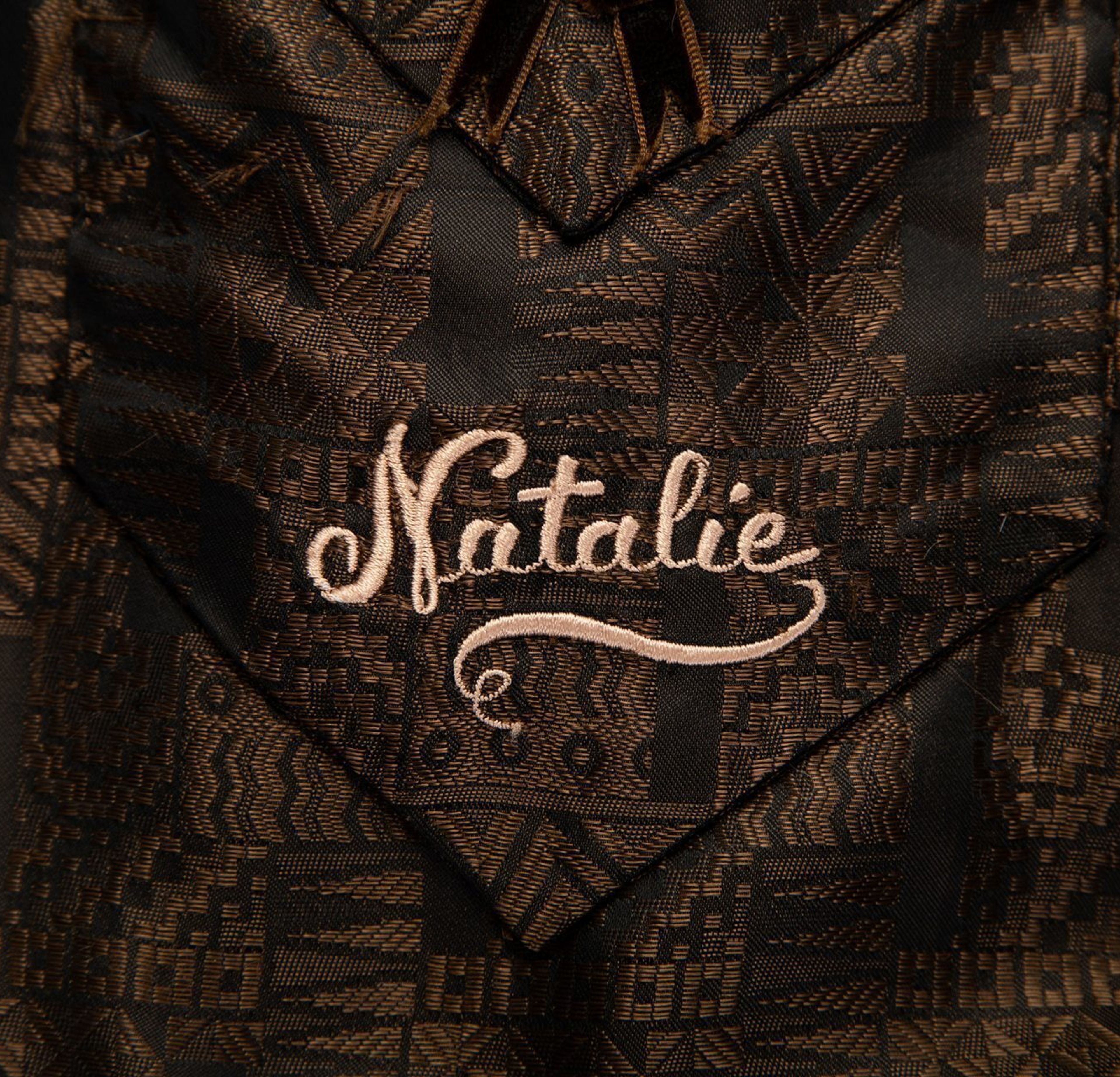
Both Natalie Cole and Audrey Morris made a mark on the American jazz scene with female vocals that riveted audiences. Natalie Cole, daughter of legendary jazz musician Nat King Cole, broke into the Jazz scene in the 1970s. As an iconic musician in her own right, she lived a colorful and effervescent life. Cole grew up surrounded by music and was introduced to her music icons through her father. Her first big splash in the music industry was in the 70s with her hit song “This will be (An Everlasting Love)”. In 1991, Cole released the career-defining album for which she is best known, Unforgettable… with Love. The album paid tribute to her father, featuring many beautiful renditions of standards previously recorded by Nat King Cole. Cole eventually accumulated nine Grammy’s and over 21 nominations, making her one of the most celebrated female artists of all time. Her collection of personally monogrammed furs will be sold at auction this December. The items offered here are part of the collection inherited by Robert Adam Yancy, her son with then-husband and music producer Marvin Yancy, who tragically passed away two years after his mother. Included are eleven furs, which carry with them a lavish lifestyle, suitable for an icon immersed in jazz, soul and R&B influences. Audrey Morris came onto the scene in the 1950s while working in Chicago as a jazz and cabaret singer. She established herself at Chicago clubs such as London House and Mister Kelly where she chose to dazzle live audiences as her authentic self after rejecting a contract from Warner Bros. But Audrey Morris would go on to record 7 albums and even open her own studio, Fancy Flaire Records. The Chicago icon was photographed wearing the intricate piece below, which speaks to an entertainer whose timelessness and authenticity shone through all aspects of their being. Preview information: Saturday, December 1, 2018, 10:00 am – 3:00 pm Sunday, December 2, 2018, 12:00 pm – 4:00 pm Monday, December 3, 2018, 10:00 am – 5:00 pm Tuesday, December 4, 2018, 10:00 am – 5:00 pm
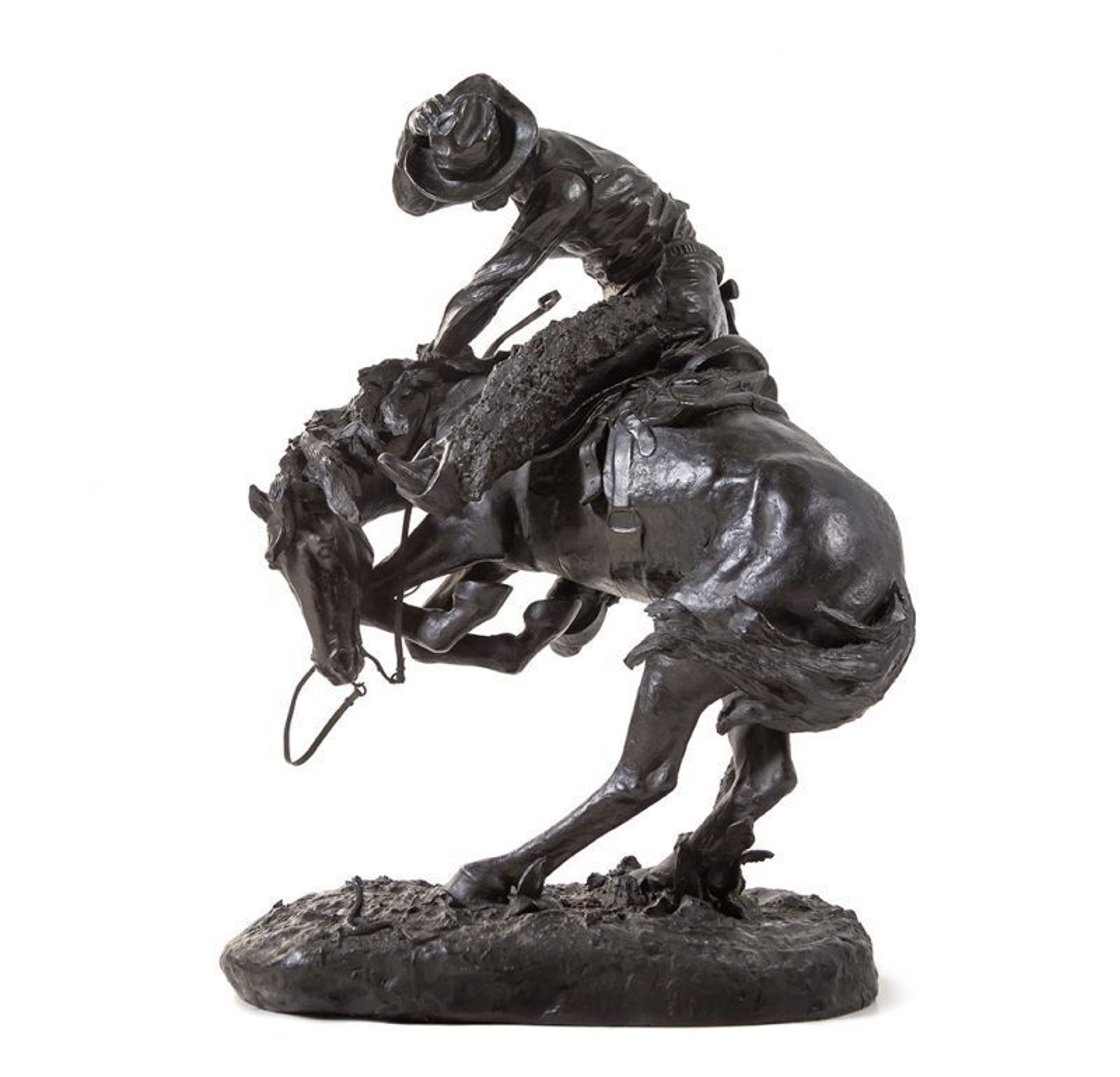
The November 9–10 Arts of the American West auction will feature The Rattlesnake, a bronze sculpture by Frederic Remington. In 1905, ten years after creating his extraordinary first sculpture, The Bronco Buster, Frederic Remington returned to the subject of the single mounted cowboy in motion on the rearing horse. When Remington created The Rattlesnake it in some ways echoed his first sculpture, but in other ways The Rattlesnake incorporates all that Remington had learned about making sculpture over the previous decade. In The Bronco Buster, the cowboy and his horse move from left to right, while in The Rattlesnake Remington reversed the format. The snake that has spooked the horse and put the cowboy at risk rises on the foreground of the base. The horse’s eyes are riveted to his diminutive antagonist and the horse has drawn back his forelegs under him as he rears back, away from the danger. The horse’s tail whips around his hind quarters, and the cowboy, who wears woolly chaps to protect himself from the cold and wind, looks down at the danger on the ground before him and firmly grasps his hat. The Rattlesnake is quintessential Remington. It depicts a moment of acute motion and intense drama, frozen in bronze. Remington had a restless imagination. He grew displeased with the awkwardly cantilevered pose in his initial version ofThe Rattlesnake, where the horse seemed about to fall backwards, and he created a new larger version around 1908. This second version of The Rattlesnake has become, after The Bronco Buster, Remington’s most popular sculpture, showing Remington in full command of his sculptural powers. In 1918 when this specific bronze was cast, Roman Bronze Works, Remington’s favorite foundry, was incorporated for the first time. The foundry marking [Roman Bronze Works Inc. N-Y-] on this specific cast of The Rattlesnake echoes that important and particular moment in time. – Michael E. Shapiro Senior Advisor, Museums and Special Collections Hindman
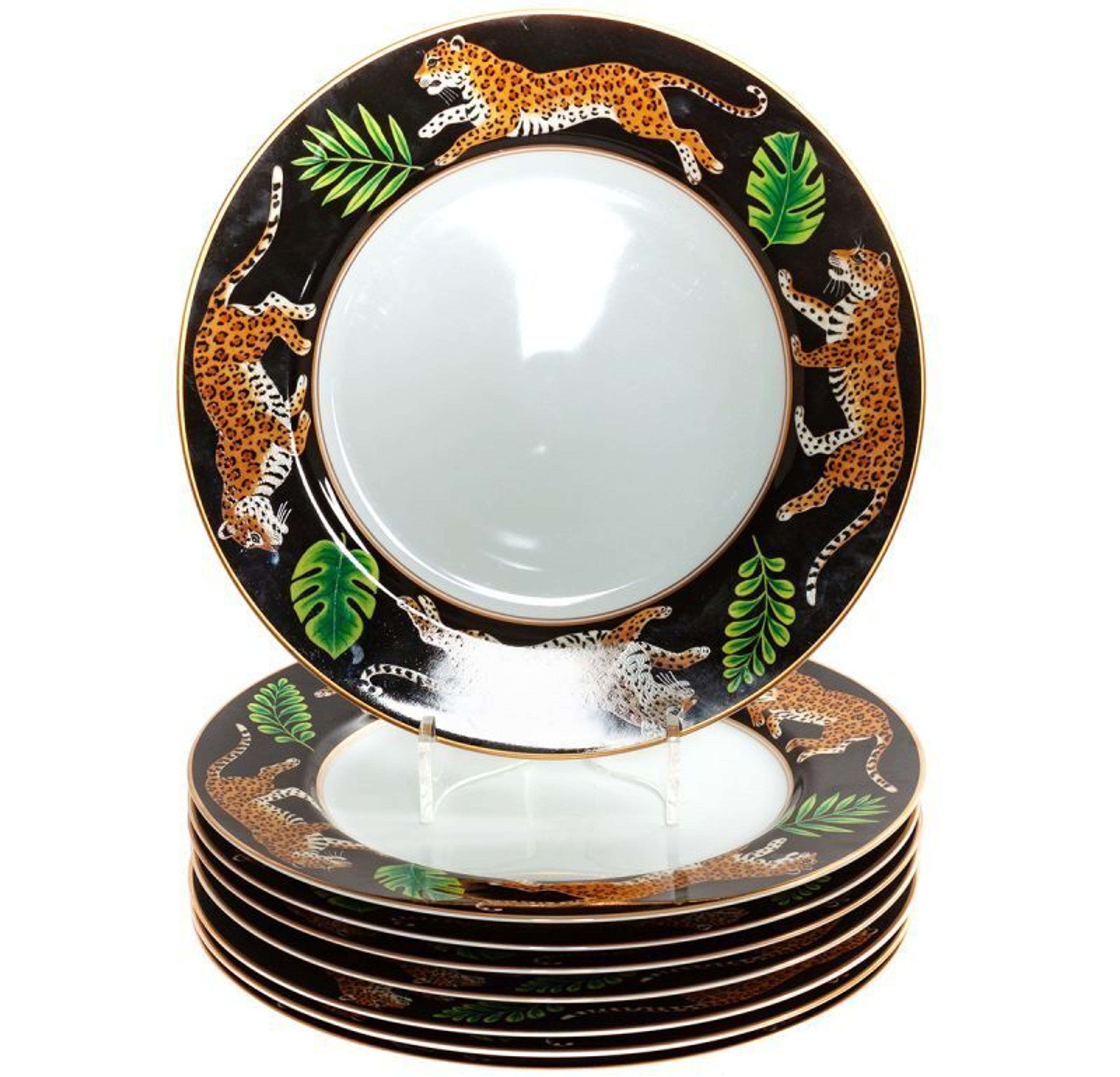
Our October 12 St. Louis Fall Auction features more than 100 lots of Lynn Chase porcelain in over 40 different patterns. Lynn Chase Designs was founded in 1988 and has been a steadfast source for whimsical, contemporary tableware ever since. In addition to designing for her home décor brand, Chase is also a conservationist and wildlife painter. Her love of animals is apparent, with creatures such as monkeys, jaguars and birds appearing often in her work. Available at auction is a variety of porcelain, suitable for numerous occasions. Liven a morning coffee with a Monkey Garden mug (lot 464), deck your holiday dinnerware with Winter Game Birds (lots 480-482) or host a dinner party in Palm Beach with Parrots of Paradise (lots 468-470) – Lynn Chase has a style to suit your most playful occasions. The St. Louis Fall Auction will offer 14 lots of Chase’s first and most popular pattern, Jaguar Jungle, including dinner services, vases, placemats and serving dishes (lots 432-445). Lynn Chase patterns are designed to be mixed and matched, seamlessly blending with both antique and contemporary china. Pieces like the Golden Cheetah porcelain chargers (lot 421) pair effortlessly with older Limoge and Minton porcelain for a timeless combination. Visit the St. Louis Fall Auction page to view the entire catalogue and register to bid for the sale on October 12.
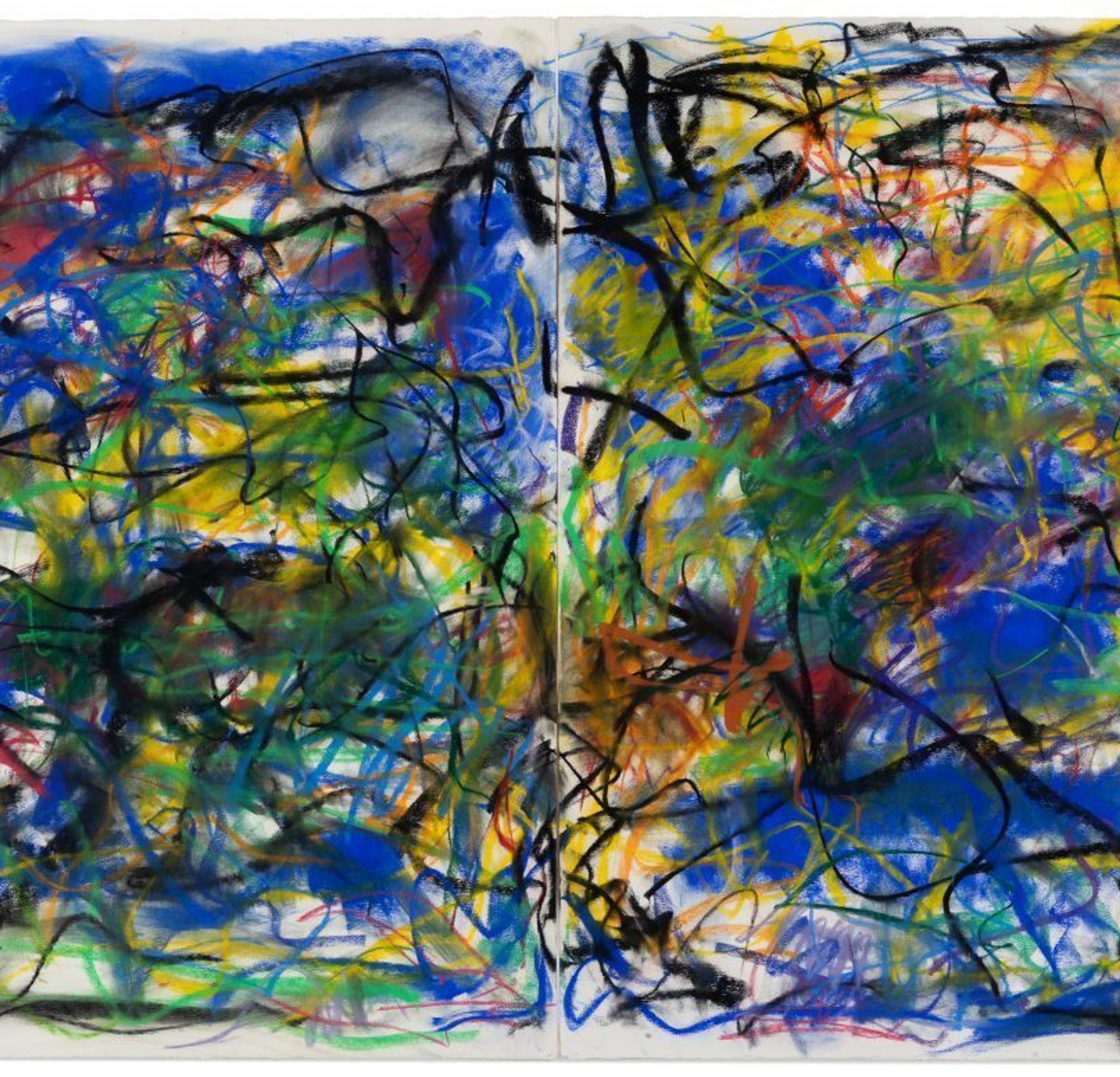
By all accounts, Joan Mitchell was as tough as they come. Aggressive. Defiant. Unapologetic. Contemporaries remember her voice as being like a worn cello. Her vocabulary rivaled a sailor’s. She was unique company. She brooked no opposition. She also was a great artist. Born in Chicago in 1925 and educated at Smith College and the School of the Art Institute of Chicago, Mitchell moved to New York in 1949 and became a central figure in the emerging Abstract Expressionist movement, exhibiting with Jackson Pollock and Willem de Kooning in the now famous Ninth Street Show in 1951. In 1959, she emigrated to France living first in Paris and then in Vétheuil, 65 kilometers northwest of the capital where Claude Monet had worked between 1878 and 1881. Monet haunted Mitchell throughout her life despite her fervent denials to the contrary. (Fact. Reproductions of his work lined her house late in life.) Like Monet’s best late work, the drawing is both dense and airy, assertive and lyrical. Each color competes with the next—the green against the yellow, the two of them against the blue, the black against all three with the crimson and orange clamoring for their own place in this finely orchestrated melee. It’s not just color that activates this dynamic diptych. Line wrestles with form, form with space, space with the flatness of the surface on which Mitchell pits masterful draftsmanship against youthful daring. Monet would have been proud to have called her a protégé. – Paul Tucker, Professor Emeritus, University of Massachusetts Boston This work by Joan Mitchell will be offered in our October 2 Post War and Contemporary Art auction at Hindman.